Monitored and Recorded Are Not the Same Word
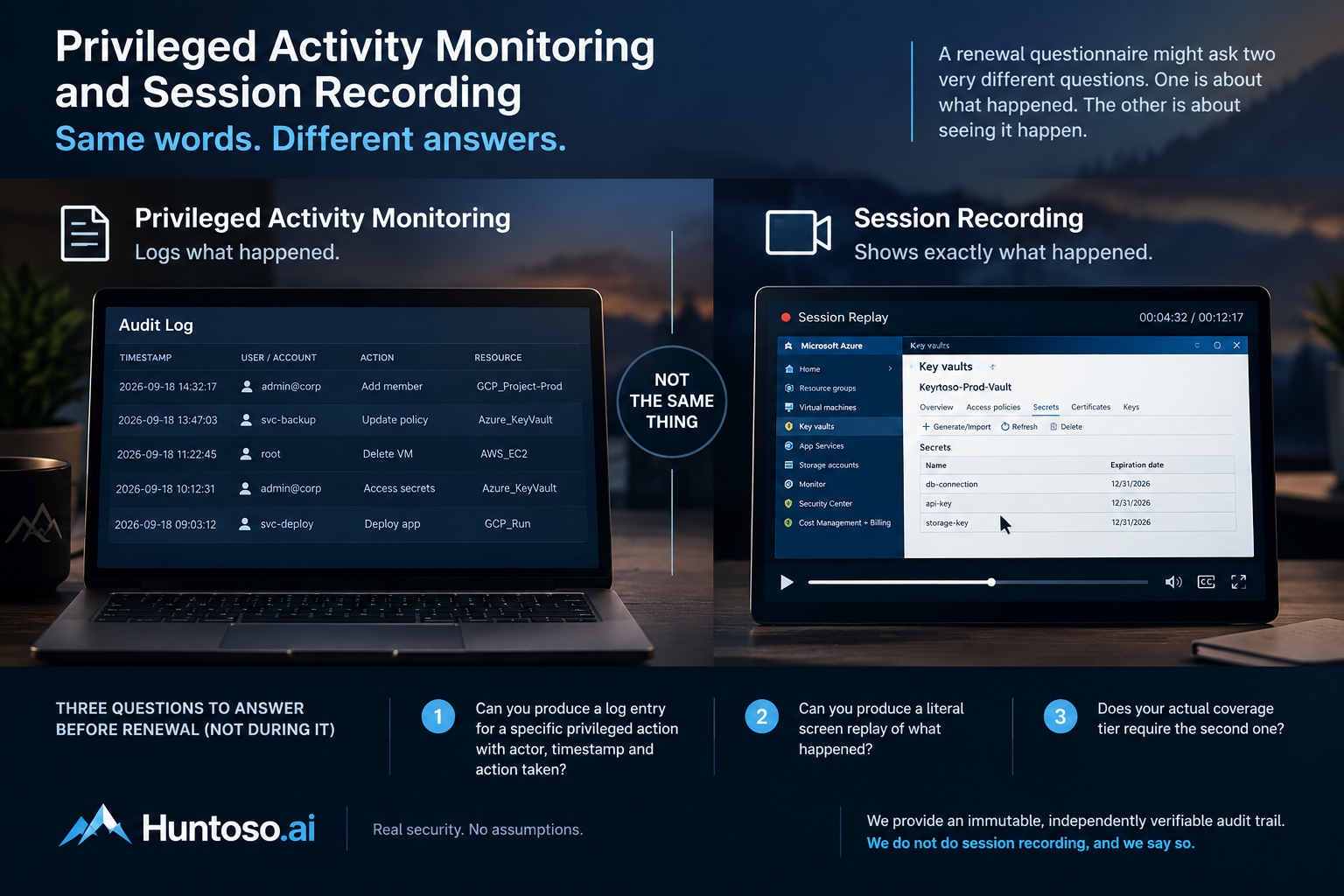
A renewal questionnaire asks whether privileged sessions are monitored, and the answer feels obvious: yes, of course, every elevated action gets logged. The box gets checked, the application moves forward, and the team moves on with reasonable confidence that the control is covered.
Then a follow-up question arrives, usually on a larger policy or a higher coverage tier, asking something more specific: are those sessions recorded, with playback available on request. This is a different question wearing the same word. "Monitored" and "recorded" get used almost interchangeably in casual security conversation, and the gap between them is exactly the kind of thing that surfaces for the first time during an actual underwriting review, not before.
Two Different Controls, One Overlapping Vocabulary
Privileged activity monitoring means that what an elevated account did gets logged: which account, what action, when, and for how long. A SIEM aggregating sign-in and action logs satisfies this. It answers "what happened" after the fact, from a structured record.
Session recording is a stricter, different control: a keystroke capture, a screen recording, or a replay URL that lets someone watch exactly what occurred inside the session in real time or after the fact, not just read a log line describing it. It answers "what happened" with a video, not a record. Carriers increasingly ask about this specifically for larger applications and higher coverage tiers, treating it as a separate line item rather than folding it into general monitoring.
Both are legitimate asks. The problem is a team that has one assumes it has the other, answers "yes" to both questions on a questionnaire, and only discovers the gap when a carrier or an incident investigator specifically requests a session replay that does not exist.
Check Which One You Actually Have
Three questions worth answering honestly before a renewal, not during one:
- Can you produce a log entry for a specific privileged action, with actor, timestamp, and what was done? If yes, that is activity monitoring, and it is the more common ask.
- Can you produce a literal replay of what happened on screen during a privileged session? If no, you do not have session recording, regardless of how good the logging is.
- Does your current coverage tier, or the one you are renewing into, actually require the second one? This is worth confirming with a broker directly rather than assuming the questionnaire's wording settles it.
Where We Draw This Line, Explicitly
PAM-Pro satisfies the first question, not the second, and we say so directly rather than letting the vocabulary blur it. Privileged actions are written as structured, tamper-resistant records under an immutability policy, forwarded independently to a SIEM the customer controls, so a carrier or forensic examiner can verify what happened without trusting our platform alone. That is activity monitoring, built to survive scrutiny.
What PAM-Pro does not do is keystroke capture, screen recording, or session replay. There is no playback URL to hand an underwriter who specifically asks for one. If that is the control a coverage tier requires, it needs to come from a session-management product or a jump host built for that purpose, deployed alongside PAM-Pro rather than instead of it. We would rather a client know that boundary before a renewal than discover it when a carrier's follow-up question lands. The full control-by-control breakdown, including this exact boundary, is in the Underwriting Impact Overview.
© 2026 Huntoso LLC. All rights reserved.