Your Renewal Evidence Is Already Months Out of Date
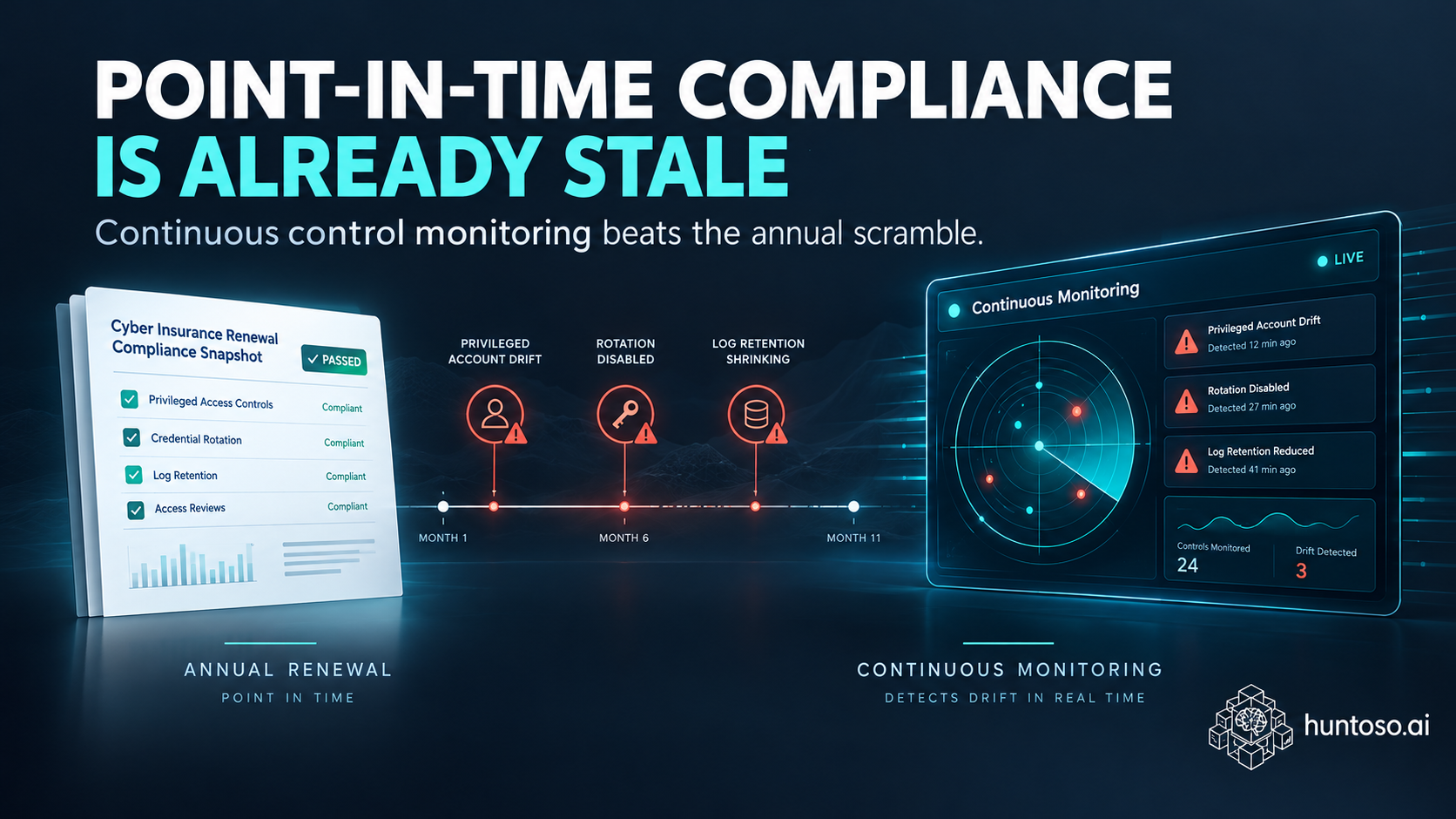
Most companies treat a cyber insurance renewal the same way: a few weeks before the deadline, someone pulls together the evidence, the application goes in, and the policy renews. For eleven months after that, nobody looks at the underlying controls again until the next renewal cycle starts the same scramble. The assumption underneath this pattern is that compliance is a snapshot, true at the moment it's captured and still true whenever it's needed again.
That assumption is getting riskier, and not because anyone is being careless. It's because the gap between renewals is exactly where real drift happens. A credential rotation policy gets quietly disabled during a migration and nobody re-enables it. A new privileged account gets created for a project and never gets cleaned up after. An audit log retention setting gets shortened to save storage costs and nobody connects that to the renewal requirement six months later. None of these show up in the annual snapshot, because the snapshot only looks backward at the moment it's taken, not forward at what happens the rest of the year.
Carriers Are Starting to Ask a Different Question
The broader shift in cyber insurance underwriting isn't just about which specific controls carriers check. It's about when they expect to see evidence of them. A point-in-time questionnaire answered honestly in January says nothing about whether those same controls were still in place in July. Underwriting practice is moving toward expecting evidence of controls held continuously between policy terms, not just produced on demand once a year. A company that can only generate a compliance picture when someone remembers to ask for one is already behind where the expectation is heading.
This matters most for the exact kind of control most likely to silently drift: credential rotation schedules, standing privileged access that should have been revoked, and audit logging that quietly stops being immutable because a retention policy changed. These are not one-time configuration choices. They are ongoing states that can degrade without any single event announcing it.
What "Continuous" Actually Means in Practice
The honest fix isn't checking more often by hand. Nobody is going to manually re-run a compliance review every month, and even if someone tried, a manual check only catches drift that happened to occur before the specific day someone looked. The fix is a system that watches the relevant controls on an ongoing basis and surfaces drift automatically, rather than waiting to be asked.
That's the premise behind PAM-Pro's compliance dashboard: a live, continuously computed score across the controls that actually matter for underwriting (credential rotation coverage, audit log immutability, managed account coverage, and critical-account rotation), with automatic violation detection the moment something drifts out of policy, not the next time someone generates a report. A tenant that passes today and drifts next month gets flagged in real time, instead of surfacing for the first time at the next renewal's scramble. The score also distinguishes a genuinely compliant tenant from one that simply doesn't have enough measured data to know, which matters because a number that can read "compliant" without actually checking enough controls isn't evidence, it's a guess that happened to look right.
The broader point holds regardless of which specific platform a company uses: if your evidence of privileged access controls only exists the week before a renewal, you don't actually know your current posture, you know what it was months ago. Continuous monitoring between policy terms is where underwriting is heading, and the gap between "we're compliant at renewal" and "we're compliant right now" is worth closing before a carrier's questionnaire closes it for you.
© 2026 Huntoso LLC. All rights reserved.